Case study · Thoughtworks
The Why Awards
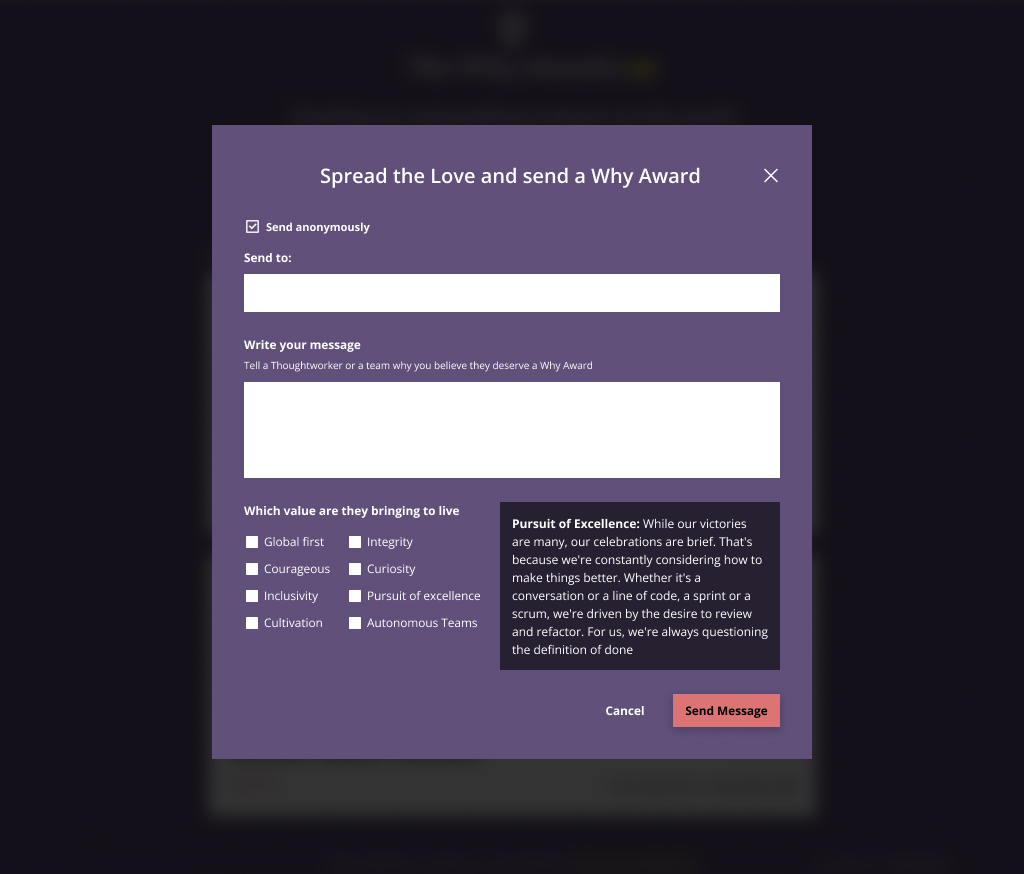
The Why Awards provides employees with a platform to recognise their peers’ efforts and share stories of appreciation. It celebrates those who embody Thoughtworks’ core values in their daily interactions with colleagues and clients.

Results
- The Why Awards won an internal contest and became a core application for employees to show appreciation for their colleagues and teams.
- Global adoption with strong employee engagement
Impact
- Increased awareness of Thoughtworks’ core values
- Positive feedback received from employees
The problem
This was a small project conceived during the pandemic. At the time, people were forced to work remotely, which weakened their sense of connection with each other and took a toll on their mental health. Thoughtworks also aimed to promote its core values to employees as a way to foster connection and resilience during this challenging period.
Business challenges
- Promote Thoughtworks’ core values to existing and new employees working remotely.
- Keep people connected and resilient during a difficult time.
The process
This product was a proof of concept (POC) developed during a 3-day hackathon within our IT organisation to address the challenge mentioned above. Despite time constraints, we applied as many design methodologies as possible. We started with a kickoff meeting to discuss the problem, establish the product vision, define objectives, and create a proto-persona empathy map. This helped us empathise with users, as we didn’t have time for user interviews.
With the user in mind, we conducted a brainstorming session to generate ideas for the product, which provided valuable insights for its design. From there, we created a concept, defined the user flow and journey, and developed a navigable prototype. The prototype was validated with randomly selected users and the product owner (PO), leading to necessary adjustments.
Once validated, we created high-fidelity wireframes and handed them off to developers. Before launch, we conducted an accessibility audit using Lighthouse and tested the app with a visually impaired user to ensure inclusivity.
My role